Strength Training at Home: What You Actually Need (and What You Can Skip)
Hello my friends.
The single most common question I get from someone about to start training at home is some version of this: what do I need to buy first?
I love this question, because it's usually a sign someone is genuinely ready to begin. And I hate it a little too, because the honest answer — much less than you think — is not what the internet has been telling you.
So let's clear this up. Here's what actually matters, what's worth your money, and what you can walk right past.
Start here: you already have everything you need for week one
I want to say this plainly. You do not need to buy anything to start strength training.
Your own body is a legitimate load. Squats to a chair, push-ups against a countertop, step-ups on a stair, sit-to-stands, a hip hinge, a carry with whatever's heavy in your kitchen — that's a real, complete strength session. I've built entire programs around it for clients who were traveling, recovering, or simply not ready to spend money on a habit they weren't sure would stick yet.
Here's why I care about this so much: buying equipment feels like progress, but it isn't. Doing the work is progress. If you spend three weeks researching adjustable dumbbells, that's three weeks you weren't training. Start with your body. Buy things later, once you've proven to yourself that you'll use them.
The three things worth buying (in this order)
When you're ready — and only when you're ready — these are the three purchases that earn their space.
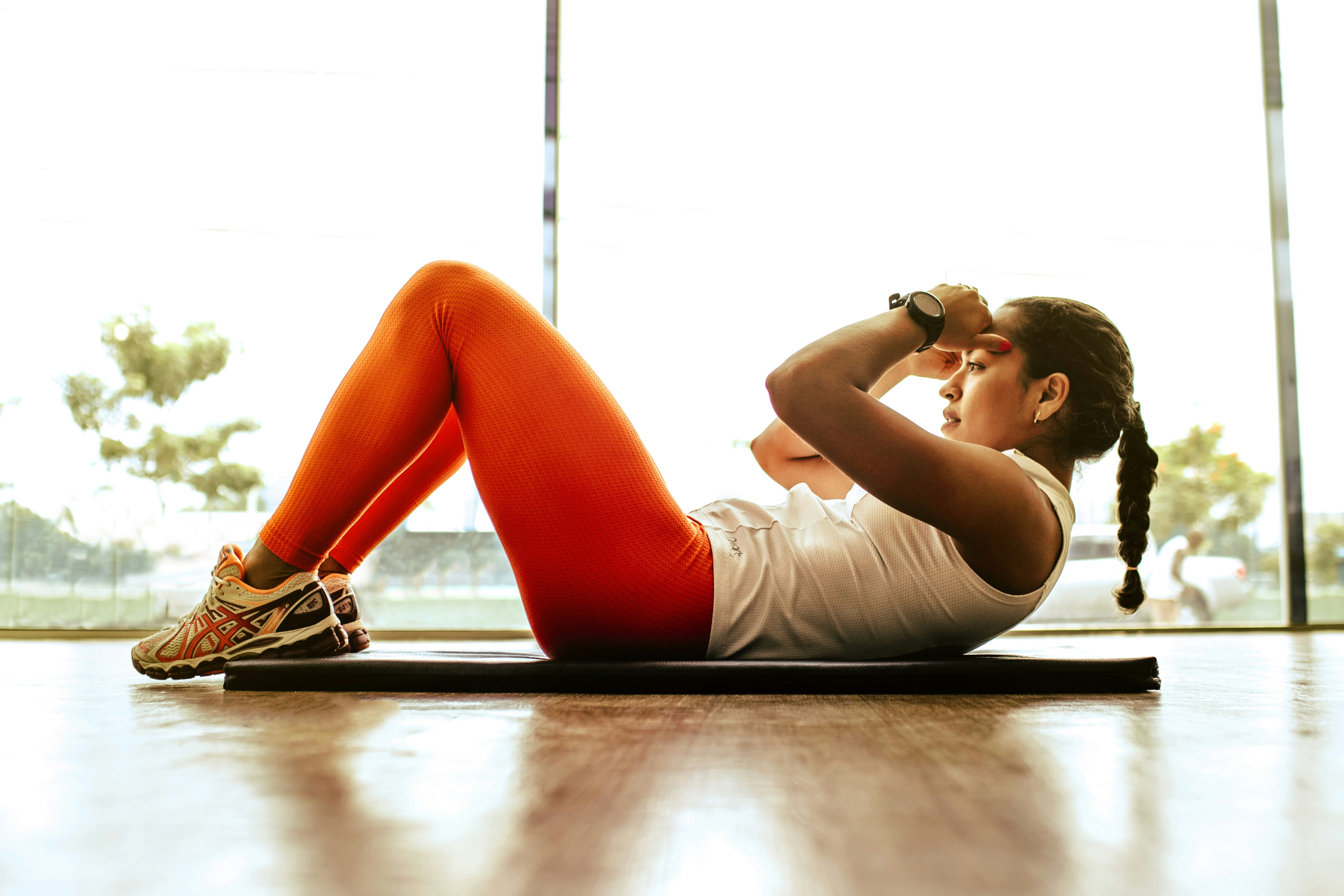
1. A mat. Not glamorous, but it changes everything about whether you'll get on the floor. Floor work is where a lot of the good stuff lives: core, hips, stretching, gentle yoga. If getting down there is unpleasant, you'll skip it. A mat removes that excuse for about the cost of a couple of coffees.
2. Resistance bands or a set of dumbbells. Either one. Bands are cheaper, easier to store, travel beautifully, and are very forgiving on cranky joints. Dumbbells are more intuitive and easier to track progress with, since a twelve-pound dumbbell is always twelve pounds.
If you're going with dumbbells, don't buy one pair — buy two. A lighter pair for upper body work and a heavier pair for lower body. Your legs are stronger than your shoulders, and they'll get bored fast if you try to make one weight do everything.
3. A sturdy chair. You almost certainly already own this one. A solid chair is a squat target, a step-up platform, a push-up incline, a balance support, and a place to sit down for a set. It might be the most versatile piece of equipment in your house.
That's the list. Mat, bands or dumbbells, chair. You can build years of strong, progressive training on that.
What you can genuinely skip
Big machines. They take up enormous space, they train one movement pattern, and they very often become expensive laundry racks. I'm not being cute — I've seen a lot of them.
The perfect matching setup. Your dumbbells do not need to match your mat. Nobody is grading you on this. The aesthetic version of your home gym is not the functional version, and chasing it is another way to delay starting.
A drawer full of apps. One plan you actually follow beats six you've downloaded. If you've got three fitness apps and you're not opening any of them, that's not a motivation problem — that's too many choices.
Anything that promises to do the work for you. If it vibrates, contracts, or shakes on your behalf, it isn't strength training. Some of these tools have a place as an add-on. None of them replace picking something up and putting it down.
Where people actually get stuck
It's almost never equipment. It's these three things:
Space. You need a spot where you can lie down and reach your arms overhead. That's the whole requirement. Living room floor, bedroom, garage. If you have to move furniture every single time, you'll stop — so pick the place where you don't have to.
A plan. This is the real gap. Standing in your living room wondering what to do is exhausting, and it's the most common reason home training quietly dies in week two. You need to know what you're doing before you walk in the room.
A realistic amount of time. Not an hour. Fifteen or twenty minutes, a few days a week, done consistently, will change how your body feels. An hour you never do changes nothing.
Your fifteen-minute template
If you want somewhere to start today, use this shape:
Three minutes: warm up. Move your joints. Arm circles, hip circles, a few slow squats. Please don't skip this — it's short for a reason.
Ten minutes: one push (push-ups on the counter), one pull (a band row), one leg movement (sit-to-stands from your chair), one carry (walk with something heavy). Two or three rounds, resting whenever you need to.
Two minutes: stretch whatever felt tight, and breathe.
That's a real workout. Do it three times this week and you're strength training.
One last thing
Training at home has a quiet advantage nobody talks about: nobody is watching. If the gym has ever felt like a place where everyone else knows the rules and you don't, your living room is a very good place to build confidence first.
Gymtimidation is real, and it's kept a lot of good people from starting. Your floor doesn't care how you look doing a squat. Start there. You can always go elsewhere later, and you'll walk in knowing what you're doing.
No matter your age or ability, you can start today with what you already have.
Ready for a plan built around your body and your schedule? Find Your Program.
LONGEVITY HABITS, HEALTHY AGING, BUILD RESILIENCE, SUSTAINABLE HEALTH, DAILY HEALTH PRACTICES, LONG-TERM VITALITY
Longevity Isn’t a Hack: How Daily Support Builds Health That Lasts
Longevity isn’t built through hacks or quick fixes. Learn how daily movement, nourishment, rest, and rhythm create lasting health and resilience.
Read more
SNACKS, WELLNESS, NUTRITION, BLOOD SUGAR
Most Valuable Snack Coordinator: Why Smart Snacks Save Your Sanity (and your arm)
A warm, humorous H2-style guide to being your own Most Valuable Snack Coordinator!
Read more
PERIMENOPAUSE, WORKOUT, NUTRITION, SLEEP
Navigating Perimenopause: Small shifts for big changes
Strong Body : Steady Glow
Read more
WELLNESS
Sleep Like a Pro: Why Your Bed is Actually Your Best Friend
Hello there! H2 here. Today I'd like to start a conversation on one of the most important things in our lives that gets over looked. Sleep! So, I'm going to cut...
Read more
WELLNESS
Meditation Made Simple: Small Steps to a Calmer Mind
Meditation can feel daunting at first. The idea of sitting in silence— no phone, no iPad, no TV, or music...
Read more




All Rights Reserved | Copyright H2 Personal Fitness 2026 | Powered by Lead Better HQ