You Don't Have to Touch Your Toes: Starting Yoga in Your Second Half
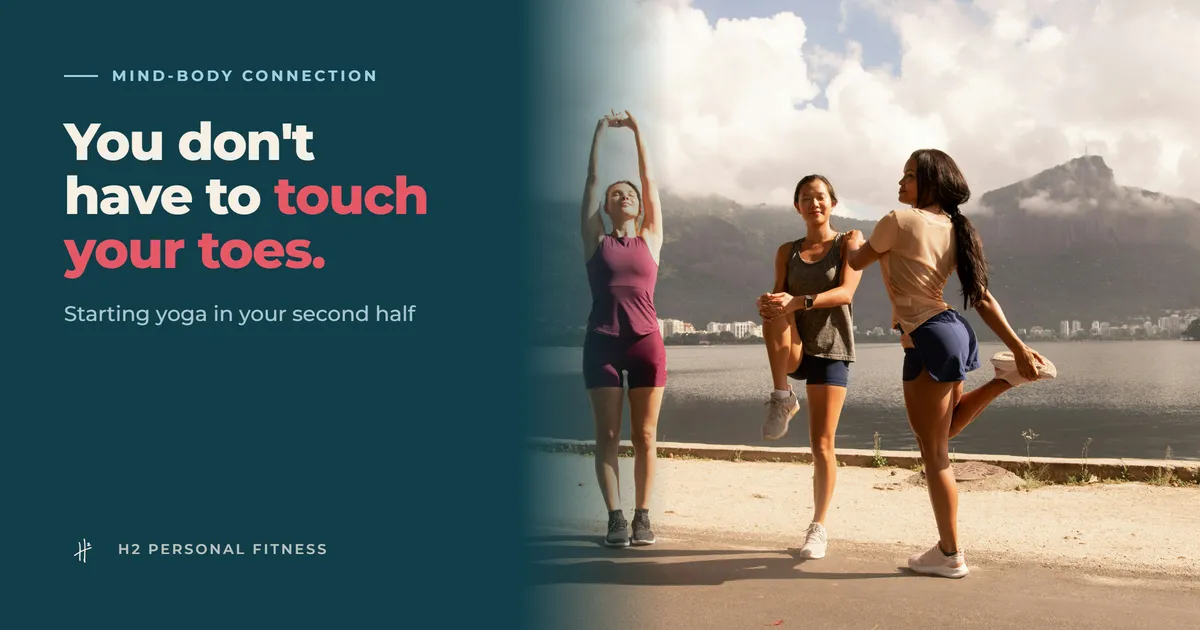
I hear some version of this almost every week: "I'd love to try yoga, but I'm not flexible enough."
I get it. When most of us picture yoga, we picture someone folded in half with their palms flat on the floor, smiling like it's nothing. If that's the picture in your head, of course yoga feels like a club you don't belong to.
So let me say this as clearly as I can: you don't have to touch your toes to do yoga. You don't have to touch your knees. You just have to show up in the body you have today, and that body is welcome on the mat.
Flexibility is a result, not a requirement
Saying you're too stiff for yoga is a little like saying you're too tired to sleep. The thing you think you're missing is the thing the practice helps you build.
Nobody walks into their first class bendy. Flexibility, mobility, balance, and that calm feeling people talk about all grow because you practice, not before. Yoga starts with where you are, not where someone on Instagram is.
What yoga actually asks of you
Strip away the fancy poses and yoga asks three simple things:
Breathe on purpose. Notice your breath and let it lead your movement.
Pay attention. Feel what's happening in your body instead of rushing past it.
Keep showing up. A little, often, beats a lot, once.
That's it. No splits required. If you can breathe and you're willing to notice, you can do yoga.
Your body has changed, and that's okay
If you're in your 40s, 50s, 60s, or beyond, your body likely feels different than it used to. Maybe your hips are tighter. Maybe your back lets you know when you've been sitting too long. Maybe getting down to the floor takes a little more planning.
None of that disqualifies you. It actually makes yoga more useful, not less. The goal isn't to force your body back into who it was. The goal is to feel at home in who it is now, and to keep moving well for the decades ahead.
This is what I mean by smart, safe progress. Not pushing limits. Building a practice that supports you.
5 ways to make yoga yours
1. Treat props as tools, not crutches.
Blocks, straps, a folded blanket, even a sturdy chair. They bring the floor closer to you so you can find the shape of a pose without straining. Some of the most experienced people I know use props every single practice.
2. Bend your knees. Seriously.
In forward folds especially, soft knees take the pressure off your lower back and let you feel the stretch where it belongs. There's no prize for locked legs.
3. Slower is stronger.
Moving slowly takes more control than moving fast. When you slow down, you build strength and balance at the same time, and you notice what your body is telling you.
4. Let your breath set the pace.
If you're holding your breath, you've gone too far. Ease back until you can breathe smoothly again. Your breath is the best gauge you have.
5. Stop before strain.
A stretch should feel like a stretch, not like pain. Sharp, pinching, or electric feelings are your signal to back off. Comfortable effort is the sweet spot.
A gentle 10-minute starter practice
Want to try it today? Here's a simple sequence you can do on a mat, a rug, or even a bed. Move slowly and breathe the whole way through.
Seated breathing (2 minutes). Sit comfortably, in a chair or on a cushion. Close your eyes or soften your gaze. Breathe in through your nose, and let your exhale be slow and unhurried.
Cat-cow (2 minutes). Come to hands and knees, with a blanket under your knees if they're tender. As you breathe in, let your belly drop and lift your gaze. As you breathe out, round your back and tuck your chin. Flow at your own pace.
Child's pose (1 minute). Sit your hips back toward your heels and rest your forehead on the floor, a block, or stacked fists. Widen your knees if that feels better.
Supported low lunge (1 minute per side). Step one foot forward between your hands, back knee down on a blanket. Place your hands on blocks or a chair seat. Gently shift forward until you feel the front of the back hip open. Switch sides.
Constructive rest (3 minutes). Lie on your back with knees bent and feet flat on the floor, about hip-width apart. Let your knees fall in to rest against each other. Hands on your belly. Just breathe.
That's it. Ten minutes. If one pose doesn't feel right, skip it. You're the one in charge here.
If you're managing an injury, recent surgery, or a health condition, check in with your healthcare provider before starting a new movement practice.
What you might notice
I won't promise you a brand-new body in a week. That's not how this works, and it's not what I'm about.
But here's what a lot of people notice when they stick with a gentle practice: they feel a little more at ease in their bodies. Getting up and down gets a bit easier. They catch themselves taking a deep breath in a stressful moment instead of clenching their jaw. They sleep a little better on the days they practice.
Small shifts. The kind that add up.
You belong here
Yoga was never meant to be a performance. It's a practice, and practice means you get to be a beginner, again and again, without apology.
So roll out the mat (or a towel, or nothing at all) and give yourself ten minutes. You don't have to touch your toes. You just have to start.
If you'd like guidance along the way, I'd love to help. I offer gentle, empowering yoga as part of my coaching, designed to meet you exactly where you are.
With heart,
Heather
LONGEVITY HABITS, HEALTHY AGING, BUILD RESILIENCE, SUSTAINABLE HEALTH, DAILY HEALTH PRACTICES, LONG-TERM VITALITY
Longevity Isn’t a Hack: How Daily Support Builds Health That Lasts
Longevity isn’t built through hacks or quick fixes. Learn how daily movement, nourishment, rest, and rhythm create lasting health and resilience.
Read more
SNACKS, WELLNESS, NUTRITION, BLOOD SUGAR
Most Valuable Snack Coordinator: Why Smart Snacks Save Your Sanity (and your arm)
A warm, humorous H2-style guide to being your own Most Valuable Snack Coordinator!
Read more
PERIMENOPAUSE, WORKOUT, NUTRITION, SLEEP
Navigating Perimenopause: Small shifts for big changes
Strong Body : Steady Glow
Read more
WELLNESS
Sleep Like a Pro: Why Your Bed is Actually Your Best Friend
Hello there! H2 here. Today I'd like to start a conversation on one of the most important things in our lives that gets over looked. Sleep! So, I'm going to cut...
Read more
WELLNESS
Meditation Made Simple: Small Steps to a Calmer Mind
Meditation can feel daunting at first. The idea of sitting in silence— no phone, no iPad, no TV, or music...
Read more




All Rights Reserved | Copyright H2 Personal Fitness 2026 | Powered by Lead Better HQ